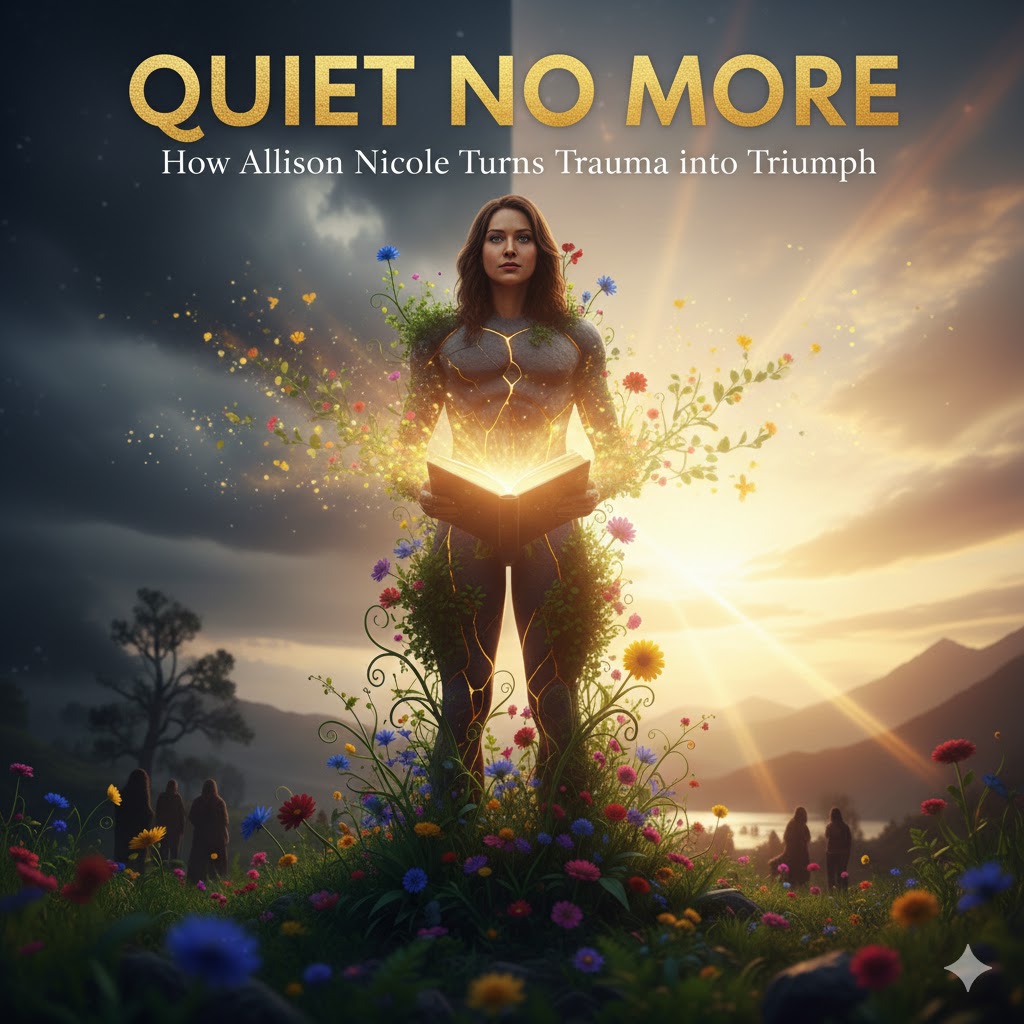
When silence becomes a survival strategy, finding your voice is revolutionary. That’s exactly what Allison Nicole has done in her piercing debut, Quiet As Kept, a memoir that refuses to whisper about pain.
In a world that teaches too many children to keep their hurt hidden, Allison found power in the page. Her first book isn’t just a memoir; it’s a testimony wrapped in truth, resilience, and unflinching honesty. From the opening pages, readers are pulled into the life of a girl whose childhood was marked by beatings, betrayal, and abandonment. But through each brutal chapter, a deeper message resonates: quietness in hurtful situations only hurts more.
This book isn’t about blame. It’s about survival. About how a little girl became a young woman who refused to let pain write her ending.
Chapter One, titled Whose Idea Was This?, is a vivid snapshot of the beginnings of that survival. We meet Allison as a 7-year-old, navigating a strict and often violent home where love and discipline were blurred. Her hair was styled like a doll, but behind her ribbons and barrettes lived a girl afraid to speak, a girl who would later realize the power of storytelling not just as therapy, but as justice.
Each memory detailed in Quiet As Kept is like a thread pulled from a tapestry of trauma. But instead of unraveling, Allison weaves those threads into a new story, one of self-awareness, endurance, and identity. One moment, she’s sneaking downstairs to watch card games from the top of the stairs; the next, she’s bracing herself against her mother’s fury, learning that love and violence had become disturbingly interchangeable.
These aren’t just stories. They’re survival blueprints. For every reader who ever had to pretend, hide, or minimize their truth just to make it through the day, Allison’s words say: you’re not alone. And more importantly, your pain doesn’t define your future.
The beauty of Quiet As Kept is in its honesty, gritty, unfiltered, and sometimes uncomfortable. But that discomfort is necessary. It forces us to confront the way we talk about trauma, especially when it comes from people who are supposed to love us most.
Allison’s reflections are not just personal, they’re universal. The neglect, the silence, the gaslighting, the emotional abandonment, it reads like a script many have lived but never written. And that’s what makes her voice so critical. It fills a gap in the literary world for Black women whose stories are too often edited or erased.
Her writing is unflinching. There are no veiled metaphors or polite euphemisms. She names names, remembers details, and reclaims the narrative. This is not just storytelling, it’s soul work.
One particularly harrowing passage involves her braids being torn from her scalp as a punishment. That moment alone could define the trauma. But Allison doesn’t stop there. She braids it back together, literally and metaphorically. In her pain, she teaches herself how to style her own hair. How to keep going. How to show up, even when her spirit is bruised.
Quiet As Kept is not trauma porn. It doesn’t exploit pain; it gives it context. It shows us what happens behind closed doors, and what happens in the hearts of children who grow up trying to survive them.
There’s a powerful moment when Allison recalls realizing she would never treat her future children the way she was treated. That single vow plants the seed for the entire book’s emotional arc. Her pain becomes her promise. Her silence becomes her story.
As a mother herself now, Allison hopes her words reach other parents. Not to shame them, but to awaken them. Because too often, pain repeats itself when it isn’t confronted. And confronting it requires more than remembering. It takes bravery. It takes voice. And it takes faith.
“Mustard seed faith,” Allison writes, a phrase so simple yet profound. It speaks to anyone who’s ever felt too broken to be whole, too damaged to heal. With the smallest faith, she says, you can start. You can speak. You can write.
What makes Quiet As Kept truly different is how personal and specific it is, yet universally relatable. Every chapter is steeped in experience, the kind of real-life chaos, confusion, and emotional warfare that isn’t dramatized for effect. It’s simply laid bare, with no apologies.
Her voice is not just that of a survivor; it’s the voice of someone who dared to break the family contract of silence. In doing so, she doesn’t just speak her truth; she gives others permission to speak theirs.
This book is a rally cry for all the kids who were told to stay quiet. For the adults still trying to understand why their inner child is screaming. For the mothers who need to hear that discipline is not dominance. For the fathers who never showed up, and the children they left behind.
This is Allison Nicole’s first published work, but it reads with the clarity of someone who’s been writing all her life. Because in many ways, she has. First in secret, then in fear, and now in purpose.
And this is just the beginning.
So what happens when the quiet one finally speaks? You listen. You learn. And if you’re wise, you speak too.
“Even when it looks bad and feels like defeat, keep going.”